
The post Making a Leased Office Your Own Space appeared first on GET TO KNOW PMI.
]]>
Decorating an office yet staying compliant with its lease can be a tricky balancing act. You want the space to stand out and reflect your brand, conveying to clients and employees alike your distinct work culture immediately upon walking through the doors.
Yet you also must weigh inevitable design restrictions. Painting walls, re-installing floors, and even hanging wall art may be off-limits according to the terms of your lease — leaving your ideas for decorating office space stifled.
With up to 80 percent of an office space's costs revolving around the lease, it's no surprise people have questions on how to decorate a business office economically and within the terms of their contract. We've put forward the trendiest leased-office design tips and tricks today, all to take your space from conventional to eye-catching.
1. On-Brand Artwork
Adding artwork is one of the surest ways of decorating an office space. It is also one of the most cost-effective, with technology and more websites and platforms than ever dedicated to inexpensive, custom office art.
Consider traditional canvas or framed pieces first. A handful of large, framed oils and watercolors are decorative staples in leased offices, adding color and personality to its likely plain walls. Hang these along stretches of main walls, or in central spots of break and meeting rooms where they can directly contribute to a more inviting ambiance. To keep things cohesive, look for multi-piece collections of framed artwork you can purchase in bulk and sprinkle throughout the office.

For something more contemporary, consider digital artwork like transfers and wall prints. Transfers are a particularly great way to incorporate branded artwork into the space, as you can use logos, photography, and brand-centric colors. Transfers can be added to canvas or paper, framed or left minimalist, blown up to cover the entirety of a wall or mixed and matched in a decorative collage.
Finally, add further aesthetic layers with pieces like figurines, statues, vases, ornaments, and other decorative items. Place these throughout the entire office, on end tables, coffee tables, conference areas, and more. Encourage your employees to do the same, whether they sit at individual cubicles or shared desk spaces.
Adding these eclectic decorative items in addition to wall art create what's called a "resimercial" look — a leading business design trend where offices are decorated to feel more comfortable through homey touches.
Just remember to keep things on-brand. From featured images to overall colors schemes, you don't want art to clash or create conflicting messages regarding what you're about. Use art to communicate your brand and business values, not distract from them.
2. Plants and Natural Elements
Decorating your office with plants and other nature-inclusive detailing is one of the most diverse and cost-effective ways to make a leased office your own.
These decorative additions have psychological benefits, too. Plant life throughout an office not only reduces employee stress, but it simultaneously boosts creativity, productivity, and reported levels of happiness. Greenery has even been shown to reduce the likelihood an employee will take more two to three sick days a year if their desk or primary workspace is located near pockets of plant life.
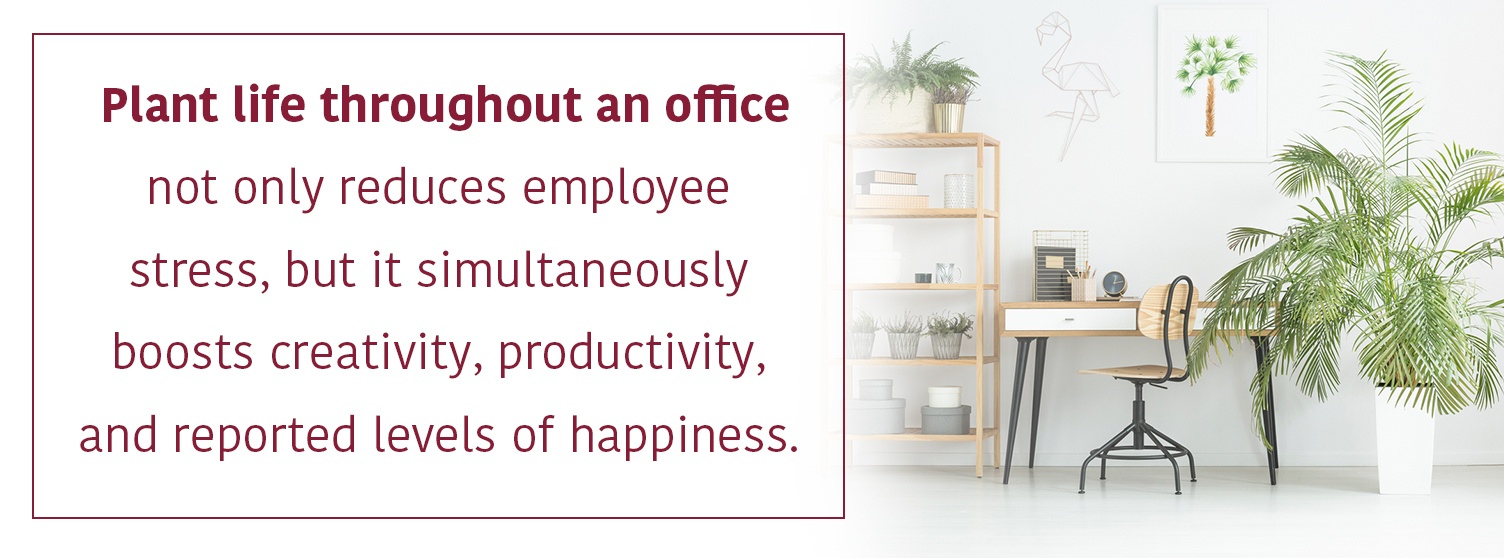
Plants are also part of a growing green trend in office design — one that's as literal as it is figurative. Many leased offices are finding creative ways to incorporate clean-air plants throughout their floor plants. They also look to pot them in "upcycled" or "recycled" pots or plantings, with refurbished items matching other art pieces and office decorations. The finished product is one that is as welcoming and calming as it is good for the environment.
Use a mix of plant and pot types when decorating an office space. For example, incorporate both standing and hanging plants with various ferns and shrubs suited for the indoors. Research the kinds of plants that grow best in your office's natural indoor conditions, with easy-to-maintain sunlight and temperature preferences.
Other popular plant-based office decorations include things like terrariums, air plants, and even vines — real or synthetic — draped from walls like artwork or used as an original office partition.
Like other things on this list, the eye is attracted to visual diversity. Think differences in colors, sizes, and locations when it comes to decorating your office with plants. Place green life in similarly eclectic containers or pots. You'll be on your way to enhancing your leased office — and feeling like a proud plant parent — in no time.
3. Rugs and Carpet Tiles
Wall-to-wall carpets and floor coverings may not be the best option to place in a newly leased space. They are expensive to install and difficult to keep clean — plus you might have to rip them out anyway once your lease is up.

Many lessees aren't partial to the carpet colors or textures that currently make up their selected space. Likewise, solid floors — like hardwood, tile, and concrete — often add ambiance and character to your office but dramatically increase noise levels. Sound waves travel and bounce around more efficiently with these floor types, then compound if your leased office has high ceilings or an open floor plan. The pros and cons of each floor type can make the other seem innately appealing, yet your lease often won't allow you to make a change.
To solve this, opt for rugs or patches of carpet tile to break up a monotonous office floorspace. Rugs and carpet tiles have the added bonus of creating structure and lending a large office more of a formal, designated layout. Plus, they are both sound-absorbing.
You can use solid stretches of carpet tiles to create paths or walkways, which is a great way to help break up open-concept offices. Likewise, rugs placed in strategic areas — such as in informal meeting rooms, collaborative workspaces or the break room — can center the space and make it feel more comfortable.
Keep an eye out for patterns and textures. Rugs can be complementary or eye-catching depending on how you pair them with their surroundings. For example, drab concrete floors of converted warehouses can be made to pop with on-brand, color complementary rugs. Natural fibers can soften hardwoods and accentuate the chairs, sofas, and artwork surrounding them. Rugs of various sizes can lend your office a cozier, homier feel.
4. Colored Partitions and Furniture
Dividers or partitions have become staples in many businesses. This is due to the reigning popularity of open-concept offices, which dominate today's business building scene due to their collaborative ambiance, maximization of natural lighting, and team-oriented, innovative nature.
Indeed, you'd be hard-pressed to find an office space today that doesn't contain some sort of open-concept architectural element. Yet that doesn't mean these kinds of designs are without flaw — particularly when it comes to employee privacy, efficiency, and stimulant-reducing productivity.
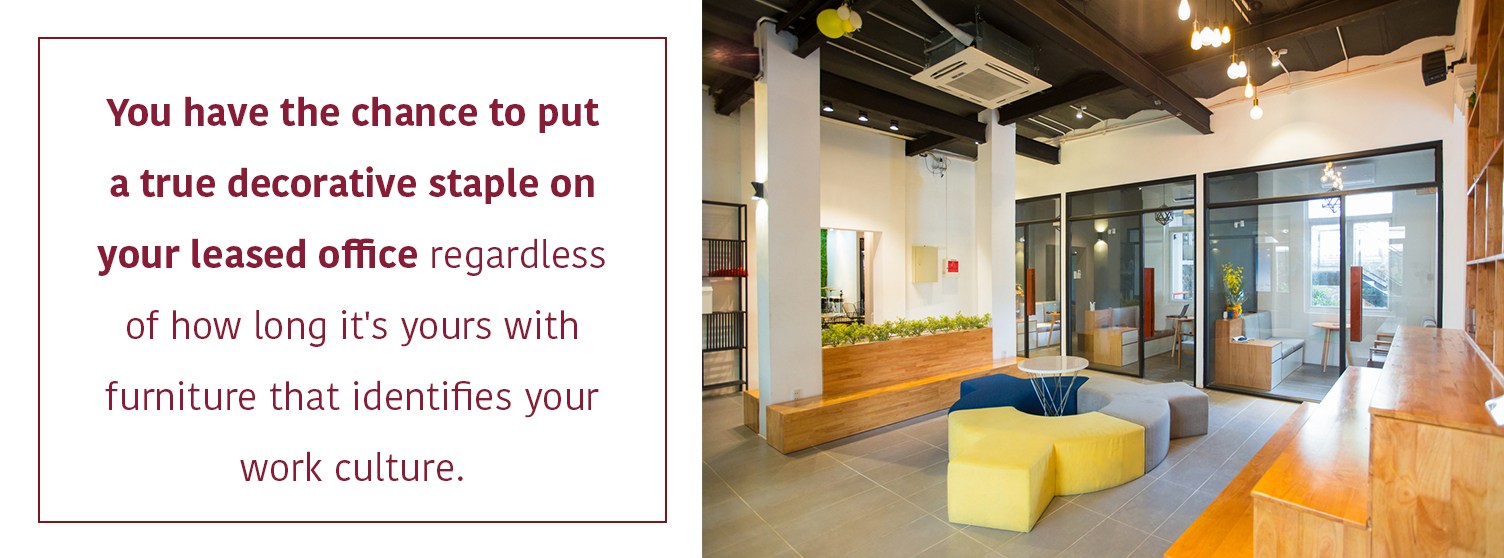
Enter office partitions. With individual worker cubicles decreasing in prevalence and wide, unobstructed floor plans becoming the office expectation, dividers are an essential — and practical — decorative inclusion.
They're as much about form as function. Mobile partitions can be used to designate or divide office departments, increase spatial flexibility, reduce noise levels, and create more dynamic and space-maximizing conference or meeting spots, planned or impromptu. Partitions also come in numerous heights, so you can pick sizes that work best with other office furniture.
The first rule for how to decorate your office space with partitions centers on colors. Opt for dividers with muted, earthy, or softened tones matching your current brand colors. Mix and match shades to give a professionally designed feel, and make sure partitions are relatively lightweight and mobile. After all, the whole point is to provide you with a more flexible, adaptive, and eye-catching use of your leased space without needing additional expensive rooms.
What's more, partitions are a great way to lend employees privacy or more isolated workspaces when they crave them. They are also vastly cheaper and more contemporary than traditional, multi-roomed offices or businesses littered with stationary cubicles.
5. Eclectic Furnishings
Gone are the days when ergonomic chairs and stationary desks did the trick. Office furnishings of today are more expansive, imaginative, and multi-functional than ever. You have the chance to put a true decorative staple on your leased office regardless of how long it's yours with furniture that identifies your work culture.
Examine furniture design periods or trends you like. Partial to mid-century modern? A fan of industrial-fashioned leathers and metals? Enjoy antiques mixed with bright, contemporary flares? Use a design trend as your guiding eye when starting to select furniture.
Begin by taking a look front-house. What kinds of couches or lounge chairs would you like arranged in a reception area, if you have one? This is the first part of your office a visitor or client will see, and it carries plenty of decorative and branding potential alongside comfort and practicality. You want the furnishings within it to present an immediate atmosphere, one aligned with the personality of your brand.
Next, determine your suite of work-related furniture. This includes but isn't limited to desks, tables, chairs, and other seating or surfaces options in your employees' main work areas plus those equipped in meeting and break areas. Like the reception area, employee furniture should convey a cultivated work atmosphere while matching the daily tasks and responsibilities of your workforce. It does no one any good if you include the coolest array of work chairs yet cram people together at shared tables, or design dynamic work pods but lack relevant technological outfittings.
It's increasingly uncommon for offices to house linear rows of identical cubicles. You have so much more decorative freedom today to furnish your leased office with unique workstations. Whether that be standing desks, work pods, shared tables, or even unassigned office seating, use furnishings that give your office character without distracting from its core functions.
If it fits your brand, you can also consider adding a few extra lighthearted pieces into break rooms, like foosball or pool tables. Just be cautious about dedicating too much space to these kinds of additions. If it doesn't fit your industry or doesn't match your targeted branding and work culture, forget it.
Last but not least, consider the furniture's finishings. Throw pillows on couches, geometric shelving, custom end tables, and more round out your leased office to give it true decorative personality.
6. Lighting
Most people imagine office lighting as row after row of rectangular fluorescent ceiling lights. These installations became the building-lighting default in the late 1970s — alongside other outdated trends like parallel rows of high-walled cubicles. Yet they are easily one of the least flattering and energy inefficient lighting choices around today — and one you can creatively hack even in a leased office.
Recent lighting trends in office spaces have shifted to highlighting standing lamps. Regardless of your renter's contract, you can add these pieces into your space. There are dozens of styles in existence, from Scandinavian minimalist to antique, stained-glass "Tiffany" style lamps. Tower lamps are ultra-sleek and contemporary, industrial lamps work well in urban, open-concept offices, and arching floor lamps break the stick-straight vertical lamp mold.
The boldest offices even fuse lighting into signs, artwork, and office furniture itself, using neon accents for a fun decorating twist.
7. Creative Filing and Storage
Storage within an office takes many shapes, yet all businesses need it. Leased commercial spaces will likely come with some built-in storage already, be those mounted cabinets or corner storage closets. Decorating an office space's filing and storage can go far beyond these options, though.
Think of all the ways you store items at home. From shelves and bookcases to baskets, bins, drawers, and display cabinets, you're familiar with multiple residential storage solutions — just in a different capacity.
Why not begin to merge these over to the office innovatively? Creative filing and storage options abound. What's more, you can get bargain deals on storage furniture at many outlet stores and online. Or for real brand-aesthetic alignment, you can commission custom cabinets and shelving units from a local business or craftsperson.
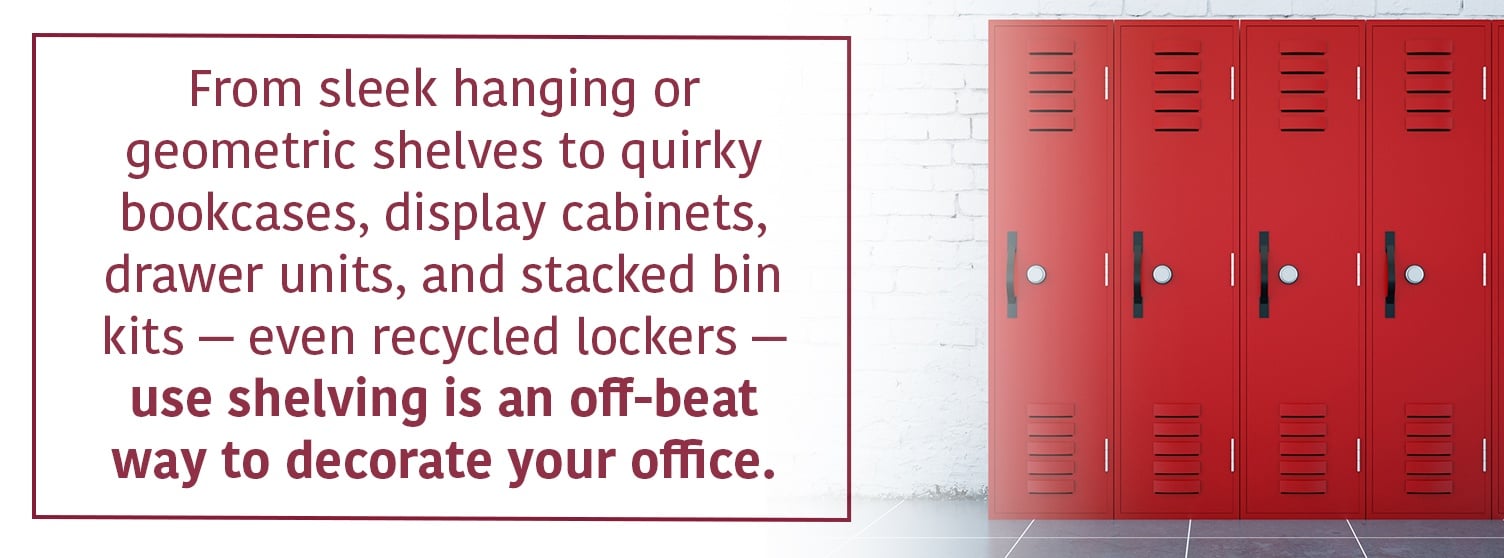
There are dozens of unique filing and storage systems to pick from. From sleek hanging or geometric shelves to quirky bookcases, display cabinets, drawer units, and stacked bin kits — even recycled lockers — use shelving in an off-beat way to decorate your office. You'll find you're simultaneously maximizing space and solving filing pain points, too.
8. Think Mobile
At the end of the day, a leased office is still liable to the terms and conditions of its contract. Most of its significant infrastructure cannot be changed.
Yet there's simply no reason to see a rented commercial property as static or lifeless. In fact, treating it so could have the opposite effect — stifling employees' spirit, reducing productivity, and turning off clients or customers.
With this in mind, keep as much of your leased office designs geared towards the flexible. Mobile furniture, partitions, and workspaces are the hot trend of the moment and the likely work norm of the future. Be preemptive about this with your leased office space today by designing work areas that are open and reconfigurable.
A mobile mindset of decorating your leased office space carries the added bonus of staying well within your lease parameters. No clunky installations or heavy, difficult refurbishments that go out of style in a few years — or that you'll have to get rid of come the end of your lease.
9. Stick to a Color Scheme
Color psychology is a significant — and scientifically backed — decorative element in your office space. The colors you choose for your space have the ability to transform the moods of those within it, for better or worse. Choose yours critically and cohesively early on with the following knowledge.
According to color psychology, perceiving different shades stimulates different psychological states in humans. It is considered a "ubiquitous perceptual stimulus" and can influence everything from attraction and fatigue to food and beverage purchases.
Blues and greens evoke a sense of calmness and thoughtfulness in most individuals. These cool shades have the interesting effect of making most people focus inward, as well. This introspective-inducing property could be useful in quieter parts of the offices, like focus rooms, or in departments where individuals need to work in controlled, composed atmospheres.
On the other hand, feelings of energy, drive, and excitement are stimulated by warm colors. Reds and oranges are bold color choices in offices, grabbing attention and creating upbeat energy. Yellows strike a psychological middle ground, stimulating creativity while also possessing a similar calming property for most people.
Pick a color scheme of four to five complementary shades, and use it as the guiding eye for selecting rugs, furniture, curtains, pillows, chairs, cushions, shelves, storage and artwork. If permitted in your lease, paint accent walls with one or two colors from your palette. Add surprising, stimulating splashes in unexpected places. Color detailing alone has the capability to transform your office from a space where people clock in and clock out to a space where people are energized, efficient, and feeling at home.
Commercial Office Space Expertise Throughout Pennsylvania
Property Management, Inc. ensures you're set up to make a leased office look and feel your own — today and tomorrow.
With over 6,000,000 square feet of managed commercial properties, you have a compelling range of options to find the space to put your business on the map. Each property comes with maintenance, repair, and management expertise plus 24-hour emergency contact so you can focus on your real priorities — launching the business of your dreams.
Explore our current commercial listings, or get in touch directly at (717) 730-4141.
The post Making a Leased Office Your Own Space appeared first on GET TO KNOW PMI.
]]>The post Updates Completed on the State College PMI Office appeared first on GET TO KNOW PMI.
]]>
Pennsylvania's Property Management, Inc. recently updated its State College rental office to better reflect our company's commitment to offering premier off-campus living accommodations.
As soon as the students and parents walk through our doors, we want to help them feel comfortable while making significant life decisions, all while signaling the quality they should come to expect from Property Management, Inc. and the peroperties we manage.
What Did We Change At Our State College Office?
After some extended work throughout the last few months, the office has a distinctively updated atmosphere that will hopefully increase workflow, grow marketing, and encourage more relaxation for students while the staff attends to their needs.
Regarding overall ambiance, the walls in the front office now sport a light blue/gray paint combination, and all the doors feature black paint for a clean, sleek look.
We improved all the passé cabinetry, hardware and countertops to help the entire space feel more contemporary compared to the old design. The beverage bar's red countertop has also been transformed as part of the overhaul.
You'll find practical improvements, too, as we got rid of the inconvenient built-in wall with the red countertop and replaced it with a table that's accessible for those with disabilities. Now, it has become an area that is much better-suited for leasing and paperwork.
Speaking of work efficiency, we enacted a change in layout. We've redesigned the floor plan to open it up, which helps maximize usage and reinforce a professional image. The changes to the entire office also made a profound impact on the front area with an increase in natural light and that immediately exposes the office to a higher amount of foot and car traffic.
Updated signage and handmade artwork serve to refine the office's student-friendly atmosphere even further.

Contact PMI's PSU Office Today
Trust PMI for safe and affordable student housing in college towns like Shippensberg and State College. You can experience the office's makeover firsthand with a visit to the location, which sits at 317 E. Beaver St. in State College. Visit us or give us a call at 814-278-7700 to schedule an appointment.
The post Updates Completed on the State College PMI Office appeared first on GET TO KNOW PMI.
]]>The post Tips for Leasing Office Space appeared first on GET TO KNOW PMI.
]]>
Moving into a new office space is an exciting milestone for any growing business. Whether your business is just beginning to bud or you're already running large-scale operations, understanding how to rent a business space successfully can unlock incredible potential for your company's future.
Researching how to find office space in your area is not particularly tricky on its own. However, you may run into some challenges when it comes to finding a lease that does not compromise your budget while also giving you the location and amenities you require. Additionally, the lease-negotiation process can seem overwhelming to new tenants who don't know the right questions to ask — questions that will ensure that both parties fully understand the agreement and are content with it.
11 Tips to Find & Sign a Commercial Lease
Here are 11 steps to finding a property and signing a commercial lease, with some tips on minimizing costs while still getting what you need.
1. Get Started Early: Set Your Goals in Advance
Kicking off the relocation process begins with setting time and cost parameters. As with any worthwhile business goal, it is vital to start by creating a plan well before you take action. Give yourself specific targets for when the new move-in date should be and how much money you will invest in relocation and new occupancy costs.

Working ahead of the game doesn't stop during the planning phase, though. Taking actions such as visiting possible new locations or contacting a property management company for advice early on also has advantages. Being proactive enables you to figure out how to lease your office space effectively — before an impending lease expiration leads you to make a rash and potentially costly decision.
2. Allow Plenty of Time to Research, Decide, and Sign
Start evaluating properties and considering your options well before the time to move in arrives. It may seem unnatural for even the smallest business to begin negotiating months and months in advance. But with transaction complications, relocation processes, communication delays, and other unpredictable factors that could prevent timely progress, it is crucial to give yourself plenty of time to select a new office space and determine a lease agreement. Six months is the recommended amount of time for small tenants, while larger companies should expect to begin evaluating options up to three years before their current lease expires.

3. Set Limits: Estimate Your Budget for Rent and Extra Expenses
When it comes to budgeting for relocation, you have to consider not only the cost of relocation, including cleaning and cancellation fees and the purchasing of new equipment, but you also should create a plan for the long-term effects of your new monthly payments. While drawing up your strategy, determine a price that will allow you to maintain operations comfortably. Stick to this price as strictly as you can.
4. The Cost Breakdown: What You Can Expect
Unaffordable rent payments could lead to growth-stunting debt, so it is vital that you have a clear picture of the rent you can afford, including additional monthly charges. As a new tenant of a commercial office space, you can expect the monthly payment to your landlord to be composed of your base rent amount by the square foot, plus Common Area Maintenance (CAM) chargesTypically, they are designed to cover expenses such as:
-
General maintenance of the exterior of the building
-
Upkeep of shared spaces like lobbies, hallways, and elevators
-
Property insurance and property taxes
-
Utility costs, depending on the lease agreement
In the negotiating phase of securing a lease, the final step in this guide, you will determine what fees you will be responsible for, but in the budgeting phase, it is vital to be aware of the possibility of paying for more than just base rent costs.
5. Quick Tips for Finding a More Affordable Lease
The factors that affect both your base rent and CAM charges the most are location, building type, and additional amenities. These are often non-negotiable necessities for your business to operate effectively.
However, there are a few tricks to keep in mind that can help you lower your monthly rate when browsing different options:
Aim for Longer-Term Leases: Grant yourself more bargaining power by opting for a more lengthy lease term. With the potential for a long-term contract, proprietors will likely be willing to negotiate on rent costs and fees. If you're shooting for a one-year lease, on the other hand, you will probably have very little control over your payments.

- Avoid Downtown, High-End Locations: For some industries, the most highly-trafficked and expensive parts of town end up being the best rental options, as the influx of business makes up for the higher prices on rent. However, for those looking for a more economical alternative, there are suburbs and growing neighborhoods with new office buildings that are on the lookout for local businesses to move in. If your company doesn't require being in a highly active or central location, consider offering the value of your occupancy to these up-and-coming areas for a more competitive rate.
-
Ditch the View: Office spaces with windows run more expensive than interior spaces without. If your budget is slim, it might be worth considering. Alternatively, you can select a windowed office with a less extravagant view to still have that natural light at a more affordable cost.
After determining your budget restraints, and while keeping these helpful tips in mind, it's time to start brainstorming the non-negotiables that your office space must have to further the growth of your organization.
6. Brainstorm: Identify Necessary Building Amenities for Your New Office
You're thinking ahead, and you've settled on a suitable budget. Now it's time to think through your current business needs and imagine what sort of possibilities a new office space could offer to help you grow. While there are many ways to do this, we recommend beginning to put together a running list of the ideas that come to mind, while making a note of the most important ones. This comes in handy not only during the brainstorming phase but also later on during negotiations.
7. Create Your Very Own Office Space Planning Checklist
The easiest way to keep track of your must-haves is to create a well-organized list of amenities that you would like to see offered in your new space. Within this commercial lease checklist, you should have a section of non-negotiables, which will help you quickly rule out selections that would inhibit your productivity.
Possible items to add to your running list include the following, although you may find that there are plenty more not listed that are high-priority for your specific business endeavors.

Space
Apart from settling for rent prices that are too high for their budgets, having an inadequately-sized area is the most common mistake new tenants make. You don't want to have an office space that is too crowded or stuffy for work to get done efficiently. At the same time, make sure you account for business growth without overestimating how much space you will need to accommodate it.
Fortunately, there is a method for determining this soft middle ground. Instead of dealing with the messiness of guesswork, get your calculator out and use recommended square footage numbers to establish a baseline estimate of what you will need.
Building Class
Depending on your industry and the standards you need to uphold, you will want to add the right building class to your checklist of details to account for. The grade or class designation of different office buildings describes the quality, atmosphere, ideal tenant base, and amenities that the building offers. Most businesses will find themselves renting space in either A-grade, B-grade, or C-grade commercial buildings:
-
Class A buildings are at the high-end, offering top-quality appearance for impressing high-profile clientele. Typical tenants of these high-rise establishments include top-notch law and financial firms. Standard amenities include elegant fixtures, superior internet wiring, and other luxuries. Naturally, the rental price per square foot in Class A buildings reflects these above-standard accommodations.
-
Class B buildings offer lovely spaces at around 30% lower rates than A-grade buildings. They're ideal for those who can forego luxury but still want to provide sleek, upscale comforts. These buildings are sometimes former A-grade establishments that have visibly aged or become slightly outdated, while other times they are intentionally constructed to be functional and comfortable without offering exorbitant rates and expensive frills. Most small businesses can find their target standards in a B-level building.
-
Class C buildings are often over ten years old and provide general workspaces for businesses that don't require the latest technologies. Out of the three grades listed here, Class C offers the most affordable prices.
While these building classifications are not strict rules, they help you set expectations for properties as you start exploring opportunities.

Layout
Not only does the total office space need to be big enough to fit your team, but the design should also accommodate the various sizes of your departments. It should give everyone an area to sit and work alongside their co-workers in their respective units. Using a list of physical assets you already have on hand or will need to provide, like desks and chairs, can help you draw out the floor plan and give you an idea of about how you will set up your office space once your lease is signed.
There are many possibilities to consider when it comes to workspace layout. For example, would you prefer an open or cubicle-based design? Depending on your office's workflow style, you may find that you need a variety of layouts to accommodate departments that function differently than one another.
You will also want to add shared areas or conference room availability to your checklist. Do you want a kitchen and designated break room? There may be times when you will want to be able to address the group at large, have big meetings, or enjoy a meal or party together, and you will need a sizeable area to do so.
Utilities
Ask yourself questions about your day-to-day activities and the types of services they require. Chances are, the answers will be high on your non-negotiables list. Some examples include:
-
How much electrical power will be sufficient? How many wall outlets do you need?
-
What does adequate lighting look like for your business?
-
What standards of air conditioning and central heating do you expect?
-
Are you prepared to cover utility costs or maintenance fees to keep them functioning?

Creating a section on your checklist relating to utilities will come in handy when the time comes to negotiate responsibilities for your lease since the costs for these services are often considered part of CAM charges.
Transportation Amenities
Parking and bicycle storage are factors that are sometimes overlooked but could not be more important. Adequate available parking affects your chances of everyone arriving to work on time without added stress.
Other Perks
Ask questions relating to daily business operations to determine other miscellaneous necessities for your building amenities. Add your discoveries to you checklist depending on importance. Some examples to get you started:
-
Do you need a way to frequently and conveniently receive packages?
-
Do you require signage on the exterior of the building?
-
What kind of alarm system is appealing to you?
This guide is merely a reference point, but there's still one major factor we have yet to address. You may have noticed that there is an essential part of relocation strategy that we have not discussed yet in depth although it's likely the most influential one of all — the location of your new office.
8. Strategize: Pinpoint the Ideal Location for Your Business Space
One of the most crucial items on your checklist is specifying the right location. It should come as no surprise that location can make or break any high-scale business endeavor.
For the sake of cost, we have already addressed how downtown or high-end real estate areas can either be problematic or beneficial depending on the industry of the business.
Apart from the effects location has on rent prices, there are numerous location-related criteria to consider when determining the place on the map for your business space. Because it can take considerable time to flush out your requirements for this category, we've compiled a few characteristics of ideal office locations.

Convenient for Employees: Finding a location that is easy for your primary workforce to get to brings enormous benefits. Employee satisfaction will be much higher without a problematic commute.
-
Strategically Placed for Recruiting: If you're still building your team, it can be a good idea to look for a centralized location that is well-suited for drawing in new talent. In an area populated with aspiring potential, your strategic location could be what persuades recent new hires to stick around.
-
Attractive and Accessible to Clients: Your building and location create an impression of your business to those who enter. If your business involves bringing clients into the office on a regular basis, you will want to consider a location that is easy to find and in a part of town that is pleasant. For clients to trust your financial stability, shoot for a middle ground between extravagant-looking exteriors and ones that are falling apart.
-
Proximity to Public Transportation or Highways: Depending on the city you are in, either public transit or major interstates are essential pathways for people visiting your company location. Your field of work could also influence what kind of transportation your typical client uses. Consider which would be more beneficial and begin tagging areas that would provide quick and convenient access.
-
Close to Amenities and Helpful Businesses: If your business requires trips to the post office throughout the day, it would be beneficial to be in the vicinity of one. Similarly, if your staff enjoys going out for lunch and coffee, you may want to consider a location with these amenities nearby. Choose a site that is conveniently located near other helpful businesses to streamline your daily activities.
Whatever location perks you decide on, don't compromise your preferences once you've made your picks. Both you and your employees will be grateful for the way you've considered everyone's needs.
9. Collaborate: Make Your Pick and Negotiate the Terms of Your Lease
After establishing a radius for good office locations, embark on a search to find four or five quality office space options. These spaces should all fit your needs and align with your checklist items. Consider getting in touch with Property Management, Inc. or another local broker for extra assistance in evaluating the locations, especially if you're just getting started.
Some tenants make the mistake of putting all of their eggs in one basket and settling on a location early on. This hasty decision-making eliminates other possibilities with which you could compare and contrast. If you spend enough time going through your options, you may find it surprising which of your top five provides the highest number of checklist items.

10. Remember Your Commercial Lease Checklist
As you sit down to discuss lease options with a property manager or landlord, pull out the checklist you've created, and go through each of your preferences and concerns. Be sure to address commonly forgotten questions that can have a significant impact on daily life at the office.
For the most part, the negotiation process is about determining your monthly rate as well as gaining a mutual understanding of what you can and can't customize on the property. Use your checklist to go over utility costs, layout possibilities, parking requirements, and other amenities you have outlined. Ask simple questions and expect simple answers so that everyone is on the same page.
11. Work With People Who Are Dedicated to Your Success
The best way to establish mutually beneficial relations with your property manager is to work with people whose goals align with your success. The most effective property management companies will know how to find office space for small businesses and large organizations alike while exceeding customer service expectations.
In this regard, there is no one more reliable than Property Management, Inc.
For Superior Property Management Services, Partner With PMI
As the premier property management company in Central Pennsylvania, Property Management, Inc. is dedicated to pairing you with the right rental property and providing the best customer service in the industry. At PMI, we will help you navigate your choices to determine the best space and location in which to grow your organization. Along with meeting your financial and functional business requirements, our staff is ready to assist you with maintenance and service needs around the clock.
Check out our selection of office spaces available to rent, and see just how enjoyable it is to discover new opportunities in Central PA.
The post Tips for Leasing Office Space appeared first on GET TO KNOW PMI.
]]>